
What are All-on-4 Dental Implants?
All-on-Four is a full-arch tooth replacement option for people who have lost most or all of their teeth in the upper or lower jaw. It uses four strategically positioned dental implants to support a fixed prosthesis.
Unlike conventional approaches that may require six or more implants, the All-on-Four technique typically places the implants toward the front of the jaw:
- Two implants are positioned vertically.
- Two implants are placed at an angle toward the back.
The angled placement can increase contact with the available bone, improve stability, and provide support across a wider area. A dental evaluation is required to determine whether this treatment is appropriate for the patient.
Why Choose All-on-Four?
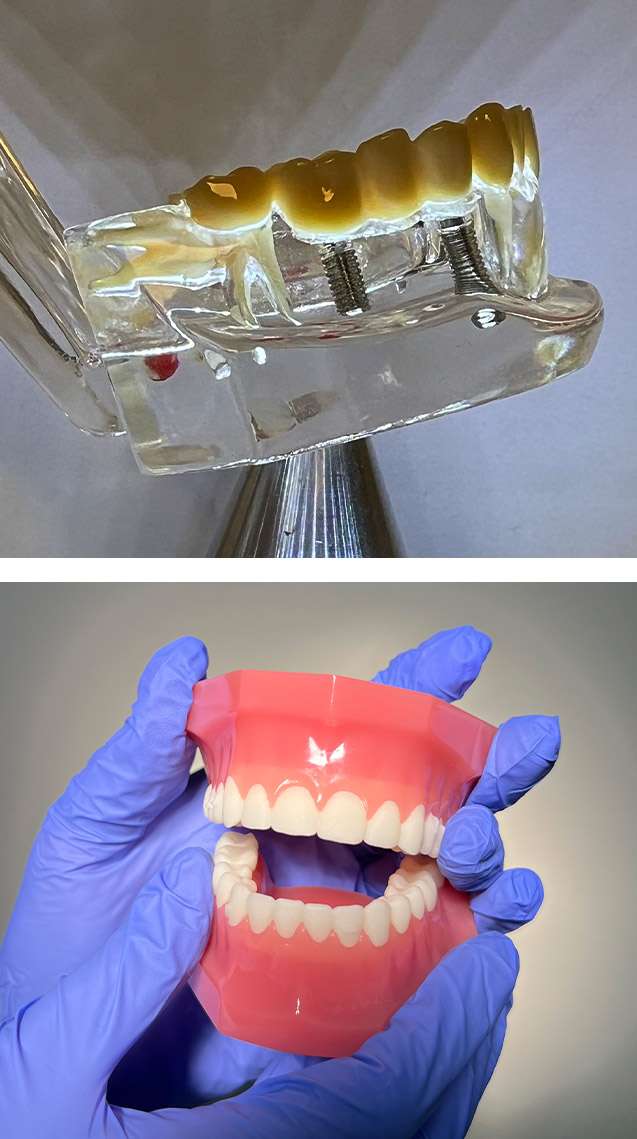
All-on-Four
All-on-Four is a treatment that is suitable for you if you are missing entire arches of teeth or have suffered complete tooth loss.
People missing an upper or lower arch of teeth, or who are entirely edentulous will struggle with full dentures that are a far from perfect solution for tooth loss. Changes to the shape of the jawbone can reduce denture retention, so they begin to slip and move uncomfortably, making it difficult to eat and even talk confidently.
Conventional dental implant treatment is one solution, but jawbone loss can affect implant placement.
Additional treatments like bone grafting may be necessary to prepare the implant sites. Bone grafting ensures there is enough healthy bone to support the new teeth. Although bone grafting is one solution, not everybody wishes to or can afford this treatment.
While treatment is highly effective, the additional procedures increase the overall cost. The time needed to complete treatment also increases as bone grafts require several months to integrate and bond with existing bone fully. Some people are not suitable for a bone grafting procedure. People with severe jawbone loss or who have particularly large sinus cavities or where the alveolar nerve is too shallow in the lower jaw might not be able to have bone grafting.
All-on-Four is a more affordable solution allowing denture wearers to replace dentures with a fixed arch of teeth. All-on-Four is useful for people who have recently lost teeth. It is recommended for patients who lost teeth years ago or have low jawbone quality or quantity, that makes them unsuitable for conventional implant treatment. All-on-Four offers edentulous patients the benefits of implant treatment. Previously these patients would have had no alternative option to traditional and uncomfortable dentures.
Who Is Suitable for All-on-Four?
To get All-on-Four dental implants, you need reasonable dental and general health. You mustn’t have any active periodontal disease, and any failing teeth may need removing before treatment. Unlike conventional dental implants, the need for strong, healthy bone is reduced because of the way All-on-Four is positioned. Treatment is specifically designed to maximize the use of healthy bone in areas where it is stronger and thicker. Anyone currently wearing full dentures or is facing the prospect of needing dentures may benefit from this solution. This is a more permanent way to replace missing teeth.
What is the Procedure for All-on-Four?
You will require an in-depth consultation with Dr. Leonard Umanoff to determine your suitability for all on four dental implants treatment. The consultation will cover your dental and medical history. Dr. Umanoff must be aware of any medical issues and medications that could affect treatment success. The consultation is your opportunity to ask questions, including all on 4 treatment costs. These costs may vary based on the final restoration chosen and the materials used during your treatment.
Diagnostic Tests
A cone-beam CT scan is required for all on four implants. It is a detailed 3-D image that allows dentists to examine the condition of their jaws closely and to more fully assess the quantity and quality of bone available. The scan also shows other facial structures in greater detail, including the location of sinus cavities, nerves, and blood vessels.
Usually, this isn’t a problem as the bone is stronger and thicker in this area, even when a significant amount of bone loss may have occurred in other areas of the jaw.
Planning Implant Treatment
The cone-beam CT scan and panoramic scan are used to plan implant surgery. The images are manipulated digitally, allowing Dr. Umanoff to insert each implant optimally. We ensure it has the greatest contact with strong and healthy bone. The images are altered digitally to show how the final prosthesis will look and function once fully restored. This step is vitally important to ensure excellent aesthetics and functionality. Once your treatment plan is complete, a surgical guide is created. The guide allows the implants to be placed using minimal incisions.
Placing Your Dental Implants
The surgical guide is placed over your gums. The dentist replicates the treatment plan accurately. It ensures every implant is inserted to the correct depth and angulation more quickly and smoothly.
Fitting Your Replacement Prosthesis
Before surgery, we create a prosthesis for fitting onto the implants soon after insertion. The prosthesis splints the new teeth together, preventing unwanted movement during healing. Although these teeth are temporary, they will allow you to eat comfortably and to talk, laugh, and socialize with others during the healing process. After your implants have fully integrated with your jawbone, you can return to LuxDen Dental Center for your permanent prosthesis.
Implant Dentures vs. Dentures
Considering dentures or dental implants? We understand the challenges of tooth loss and its impact on your smile, eating, and overall oral health. Our dentists offer both options to help restore your confidence.
Dentures are removable, artificial teeth that can be full or partial. They require adhesive to stay in place and separate cleaning. While dentures are more affordable, they don’t address jawbone deterioration.
Dental implants are permanent replacements that look and feel like natural teeth. They’re typically made of titanium and require surgery to place. While more expensive, they help prevent jawbone loss.
To determine the best option for you, consult our dentists at LuxDen. We often recommend dental implants to prevent long-term health issues associated with missing teeth.
What to Expect After Receiving All-on-Four Dental Implants?
Because only four dental implants are required, healing should be relatively comfortable. Any discomfort will be minor and is usually easily controllable with over-the-counter painkillers. We will provide precise instructions on how to care for your mouth during the healing process. Our dental team is always here to answer queries or concerns.
Contact Us


